
The existence of corporations has long fascinated me, today more than ever. We are entering an era of planetary-scale technology companies, where cloud infrastructure, addressing systems, data centers, and more have become an accidental megastructure that reorganizes sovereignty more thoroughly than perhaps any political revolution in the last century. The modern corporation approaches the power of a nation-state, without ever being designed as such. However tempting it is to treat the modern corporation as a unique phenomenon, perhaps even a uniquely AI-era one, it isn’t. The private corporation has been a predominant vehicle through which the largest shifts in economic and technological power have been built and distributed, through railroads, oil, finance, and now compute. Understanding how this institutional form has evolved – taking the historical long view – is essential to understanding what’s happening today and what levers we have to intervene.
To begin, every era of American corporate law has attempted to answer the same two-part question. Beyond shareholders, which stakeholders does a corporation answer to in practice, and what makes that accountability both incentivized and enforceable? This answer is rarely settled by argument alone. Rather, it shifts when a crisis makes the existing arrangement untenable, and it moves through concrete interventions – legal form, new institutions, regulation, stakeholder standing, financial engineering, and disclosure – not sentiment.
This essay series attempts to do three things. In this first part, I trace the history of American corporations across five eras and map major mechanisms for stakeholder recognition. The second part applies this typology to frontier AI labs, arguing that (a) today’s corporate AI laws do not map cleanly onto these mechanisms and (b) the nature of AI development and its impact necessitates the recognition of new stakeholder groups. The third part transitions to design, first examining interventions and framings of the corporation which have already started to emerge, then putting forth my own.
A Short History of the Corporate Stakeholder
The Chartered Corporation (1780s - 1880s)
The early American republic needed infrastructure that state governments could not finance alone, among them canals, turnpikes, bridges, waterworks, and banks, all of which required pooled money and limited liability. The corporate charter was the instrument states used to channel private money toward a public end. Incorporation was a privilege the state extended, not a right the company held. A legislature would charter a named group for a stated purpose, usually for a fixed term, and the corporation existed to serve a defined community of users and ratepayers. In fact, before 1801, fewer than four hundred business corporations were chartered in the United States. Their purposes were written narrowly enough that acting outside the granted powers was ultra vires1 or void as a matter of law.
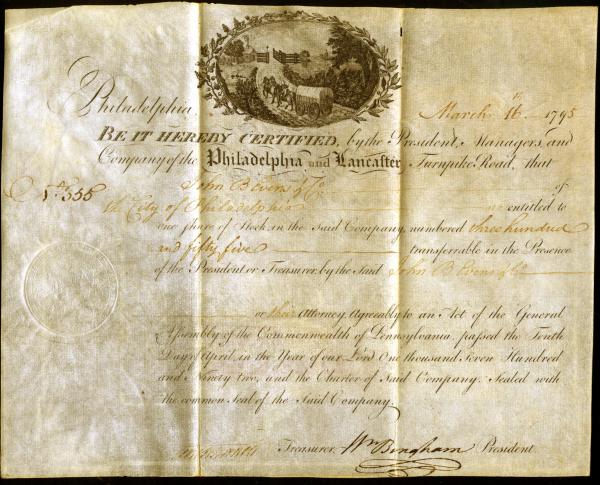
Pennsylvania chartered the Philadelphia and Lancaster Turnpike Road Company this way in 1792, after concluding it could not afford to build the sixty-two mile road itself, letting a private company raise the capital through a thousand shares at three hundred dollars each and recover it through tolls. The charter fixed these tolls gate by gate, down to six and a quarter cents for a horse and rider, with the road bound to be kept in repair on the threat of losing the right to collect. Compare the specifications of this charter with the rules of incorporation today. As an exercise to the reader, try to stand up a Delaware corporation. You can do so through a same-day service for about $150, or pay $1,000 and Delaware will hand you the Certificate of Incorporation in an hour.
Fig. 1A share in the Philadelphia and Lancaster Turnpike Road Company, issued in 1795. Each share bought a fractional claim on the road toll’s income, paid out as dividends only when the directors chose to, and like most turnpike stock of the era, returned little (as pricing was capped by the charter). This model backed the country’s first long-distance toll road and was used to finance some twelve thousand miles of turnpikes by the 1830s.
During this era, the primary stakeholder of corporations was the commonwealth, or the local public the enterprise was chartered to serve. The legislature’s enforcement ability was derived from the ability to refuse renewal or completely revoke the charter. Indeed it exercised this right. In 1811, Congress let the twenty-year charter of the First Bank of the United States lapse on account of a single vote in the House.
This whole framing might seem difficult to reconcile with our modern lens, but it’s important to recognize the dominant framework of this time: civic republicanism. This was a Revolution-era tradition of political thought which stressed the interconnection of individual freedom and civic participation with the promotion of the common good. The early American republic boomed with large public works like canals and water utilities as well as smaller civic organizations like volunteer fire companies and libraries. The corporation was seen as yet another institution of the community and was treated in kind as a creature of the state, held to its purpose, rather than as an autonomous private actor which we recognize culturally and in law today.
This chapter of corporate history closed with the case of Trustees of Dartmouth College v. Woodward in 1819. New Hampshire tried to convert the college, chartered by George III in 1769, into a state university by rewriting its charter and handing trustee appointments to the governor. Daniel Webster argued on behalf of the college, and the Court held, over a lone dissent, that the charter was a contract. Webster argued using the Contract Clause of Article I of the U.S. Constitution2, which forbids a state from passing any law impairing the obligation of contracts. Thus, New Hampshire could not alter the deal from one side without the corporation's consent. This single decision took the right to revoke a charter out of the state’s hands and marked the start of a longer migration3 of the corporation from a public instrument towards private property. The older logic, however, didn’t fully disappear. Within the same Dartmouth case, Justice Story’s concurring opinion suggested that states could still reserve the power to amend or repeal the charter by writing this right into the charter at the time of incorporation. States started including this reservation into every charter, then into their general incorporation laws as a matter of course.
That reserved power has proven to be unexpectedly modern. In May 2026, Hawaii enacted Act 11, effective July 2027, stripping corporations operating in the state of the power to spend on elections, on the grounds that political spending was never among the powers the state granted when it recognized them as corporations in the first place. The argument invokes pre-Gilded Age logic. A corporation holds the powers its state confers and no others4. More than a dozen states are weighing the same move, including Montana5, New York, California, and Massachusetts. However, Delaware, where most large firms actually incorporate, isn’t among them.
The Gilded Age and the Birth of the Modern Corporation (1880s to 1920s)
By the 1880s, railroads, steel, and oil needed capital and reach that no single state’s charter was built to provide. These were industries that needed to operate across several states, but a corporate charter up until this point only gave a company legal existence and rights within the state that granted it. Already, companies were finding workarounds.
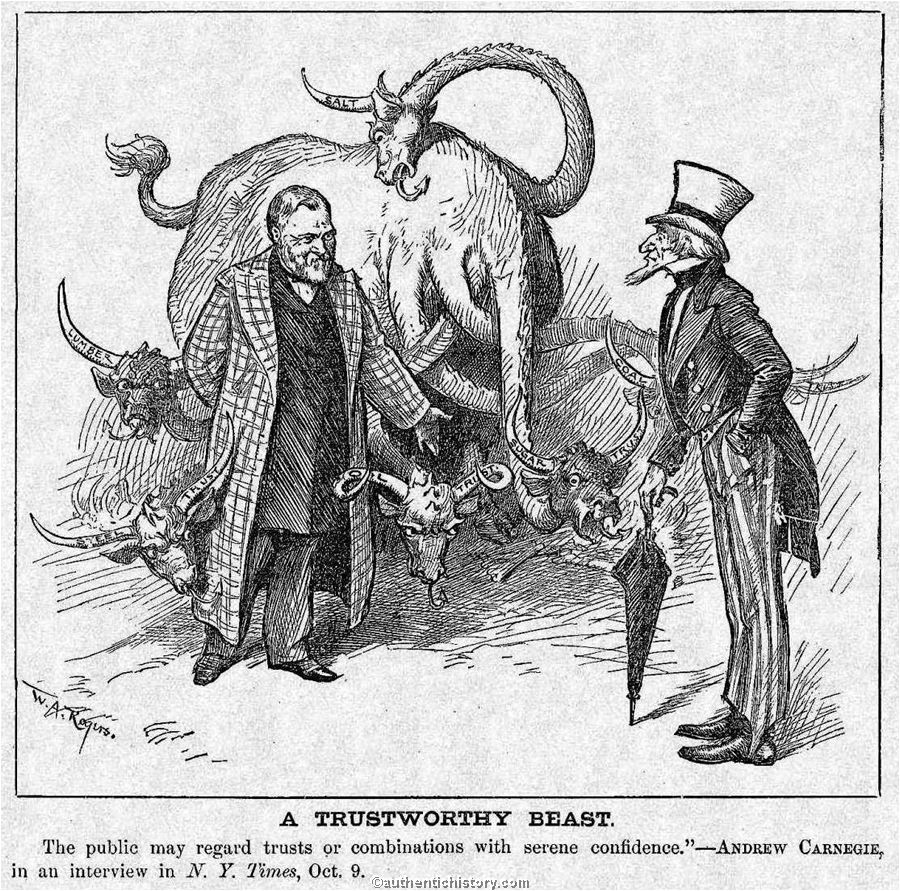
Standard Oil ran dozens of separately chartered state corporations and attempted to manage them as a scattered federation. This, however, was unwieldy because corporations were barred from owning stocks in a company chartered elsewhere. Standard Oil found yet another route. In 1882, Standard Oil’s lawyer Samuel Dodd revived the trust, under which the shareholders of separate corporations handed their shares to a small board of trustees. Trustees then controlled all the companies and set their dividends6.
Fig. 2Carnegie reassures Uncle Sam that the many-headed trust is tame. Harper’s Weekly, 1888.
New Jersey later turned this arrangement into law in 1889 and 1896, lifting the limits on capital, letting corporations exist in perpetuity and pursue any lawful business, and, most consequential of all, permitting one corporation to own the stock of another. This legalized the holding company and made the trust obsolete. The resulting revenue was staggering. By 1902, New Jersey had paid off its state debt and abolished property taxes on the strength of incorporation fees alone, which earned it the name “Mother of Trusts”. Delaware followed New Jersey7 in 1899. This race to the bottom in corporate law produced a lasting model. Most large companies, including today’s frontier labs, still choose to incorporate in Delaware. Delaware’s corporate law functions as something close to the nation’s default.
Capital then combined at a scale the country had never seen before. Between 1895 and 1904, more than eighteen hundred manufacturing firms consolidated into a few hundred corporations, many controlling well over half of their markets. In 1901, J.P. Morgan fused Carnegie Steel and nine other firms into U.S. Steel, the first billion-dollar corporation. The concentration was a direct result of permissive incorporation statutes which turned secretive trusts into the ordinary corporation which could raise capital and sell shares openly.
This concentration of power was seen largely as a threat to consumers and to competition8, and the government acted accordingly. In 1877, the Supreme Court ruled in the case of Munn v. Illinois that businesses affected with a public interest could be regulated. That principle was then used to build the era’s reforms. The Interstate Commerce Act of 1887 created the first independent federal regulatory agency to oversee railroad rates. The Sherman Antitrust Act of 1890 outlawed monopolization, and the Clayton Act of 1914, backed by the newly created Federal Trade Commission, banned price discrimination and interlocking directorates. Theodore Roosevelt's Justice Department directly applied these tools, breaking up Morgan's Northern Securities railroad holding company in 1904 and Standard Oil itself in 1911.
The stakeholders legitimized within this era and given standing were consumers and competitors injured by monopoly practices. The interventions of this age policed the structure of markets, but stopped short of modifying the internal governance of the firms themselves. Importantly, what was left untouched by these interventions was the enormous power these firms held over their workers and their ability to organize. In 1892, management at Carnegie’s Homestead Mill brought in armed Pinkerton agents to break up a strike, leaving around ten men dead.
This chapter of American corporate history left a major problem that the New Deal era would inherit. These giant companies were financed by selling stock to the public, which scattered ownership from a concentrated few, e.g. founders and bankers like J.P. Morgan who financed deals, to millions of small and anonymous shareholders. This happened within a generation. These shareholders owned the corporation on paper, but they had little say in running it, while the managers who ran the firm held little stock. The modern corporation was born. It was large, public, and accountable to almost no one inside of it.
The New Deal (1933 to 1945)
By the 1920s, the market ran on borrowed money and easy credit. People bought stock on margin, borrowed aggressively, and bought on speculation because companies had no duty to disclose finances.
When the bubble broke in October 1929, losses cascaded. The market lost roughly nine-tenths of its value by 1932, between a third and half of American banks failed, and unemployment reached one in four. Millions of people faced foreclosure. The scale of the damage fundamentally changed what a corporation was understood to be. A firm large enough to eliminate millions of jobs was no longer purely private but a quasi-public institution.
A new framing of the corporation was fast arriving, one where a firm’s own internal structure, not just its external conduct, became the government’s business.
Adolf Berle, a Columbia law professor advising Roosevelt since the 1932 campaign as part of his Brain Trust9, influenced much of this framing. With economist Gardiner Means, he argued in their 1932 landmark book, The Modern Corporation and Private Property, that ownership had come apart from control, leaving millions of shareholders with paper claims to companies but without the proper mechanisms to monitor or steer the company.
This analysis of corporate misalignment directly shaped the drafting of the Securities Act of 1933 and the Securities Exchange Act of 1934, two foundational pieces of legislation which formally recognized shareholders within corporations. The Securities Act of 1933 required companies to disclose accurate financial information when they sold stock. The Securities Exchange Act of 1934 extended that duty to existing shares and created the Securities and Exchange Commission (SEC), a standing federal agency with the power to police fraud and force continuous disclosure from public companies. The same act gave shareholders the proxy, a channel to receive real information and cast their votes ahead of a company's annual meeting without attending in person, turning nominal ownership into leverage10.
The Wagner Act of 1935 extended protection to labor, but on separate intellectual footing. Senator Robert Wagner had long been arguing that only a real shift in power toward workers could end the violent strikes across American industry, but it wasn’t until the Depression that the economic case was made. Economists offered another argument for worker’s rights; they blamed suppressed wages for starving the broader economy of the purchasing power needed to recover from the Depression. Together, these two arguments produced the Wagner Act. The law established employees’ right to form unions, bargain collectively, and strike. It also created the National Labor Relations Board (NLRB) to run union elections and punish employers who fired organizers. Union membership rose from three million in 1933 to more than fifteen million by 1946. In early 1937, a sit-down strike won the United Auto Workers a contract at General Motors. Within weeks, U.S. Steel preemptively recognized a steelworkers union. That April, the Supreme Court upheld the Act in NLRB v. Jones & Laughlin Steel11, confirming that federal power reached inside industrial employment.
The New Deal also built new financial instruments and rules such as federal insurance, against risks from the corporation that the crash had exposed the public to. The Glass-Steagall Act of 1933 separated deposit banking from securities trading; a bank could no longer gamble with the savings it held. The law also created federal deposit insurance, a government guarantee against bank failures, initially at $2,500 per account. The Social Security Act of 1935 also made corporations partly responsible for workers’ retirement, funded through a payroll tax split between employers and workers. A new form of welfare was emerging, shaped by the poverty and populism of this era.
The new social contract between corporations and society put forth by the New Deal formally recognized two new stakeholders, shareholders and workers. The protection of these two groups were effectively converted into standing institutions. Both the SEC and the NLRB are still active and foundational to how capital markets and labor relations are governed today. The SEC is the central regulator of American public companies and markets, and the NLRB oversees a private-sector workforce that is now about six percent unionized. This chapter also extended corporate duty beyond wages and votes, through Social Security.
The Stakeholder Interlude (2001 to 2019)
A run of pressures over two decades made shareholder primacy appear both illegitimate and financially naive.
At Enron and WorldCom, the stock-based pay meant to align executives with shareholders instead rewarded falsifying earnings; both firms collapsed in 2001 and 2002 in the then largest bankruptcies in American history.
The 2008 financial crisis went further. Risky mortgage lending by banks froze credit markets worldwide, and the federal government spent $700 billion bailing out institutions on the grounds that they were “too big to fail”.
Meanwhile, two slower moving pressures built. Investors began pricing a warming climate as a financial risk, and widening income inequality corresponding to populism made the shareholder primacy model harder to defend.
Ownership also changed. Index funds made BlackRock, Vanguard, and State Street large shareholders in almost every major company, exposing these investment firms to large systemic risk from the whole market.
This era gestured at diffuse stakeholders: the workers and communities a company affects, the environment, future generations, and the public as the ultimate absorber of systemic risk.
The main instrument for representing them was ESG, a framework for scoring companies on environmental, social, and governance factors that investors could use to screen what they held.
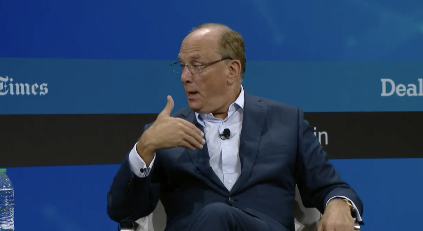
BlackRock’s Larry Fink20 was ESG’s outspoken advocate. He urged executives in his 2018 letter to serve stakeholders including shareholders, employees, customers, and the communities in which firms operate, and in 2020, to treat climate as investment risk.
This instrument, however, was weak. ESG scores diverged wildly across rating agencies, their promised effect on a company’s cost of capital largely failed to materialize, and unlike shareholders, the stakeholder groups ESG outlined gained no financial stake or enforceable standing.
Fig. 3
Larry Fink at the 2022 New York Times DealBook Summit. He frames shareholders as the primary stakeholder but argues that serving them well means serving a broad stakeholder class as long-term profits, not short-term populism, depends on it. He also describes BlackRock’s proxy voting choice initiative which allows individual plan holders to vote their own shares.
One subtle defense of shareholder primacy from this era came from economists Oliver Hart and Luigi Zingales, who argued that maximizing a company’s market value isn’t the same as maximizing what shareholders want. Shareholders aren’t purely maximizing returns, and many are willing to accept a lower return for outcomes they care about ethically.
This framing keeps shareholders at the center of the firm but asks companies to optimize for welfare over wealth.
This era also produced enforcing legislation. Sarbanes-Oxley in 2002 required chief executives to personally certify financial statements and created an accounting oversight board; Dodd-Frank in 2010 added a council to watch for systemic risk and a bureau to protect consumers.
Perhaps the most interesting innovation during this period was the creation of the Public Benefit Corporation (PBC). Founders feared that ordinary corporate law would force them to abandon a mission under shareholder pressure. The 2010 case eBay v. Newmark confirmed this fear when the court ruled that a mission cannot legally override shareholder value at a for-profit Delaware corporation21. No legal form existed yet to protect a founder who wanted to deliberately navigate the tradeoff between mission and shareholder pressures.
B Lab built one. The nonprofit was founded in 2006 by Jay Coen Gilbert, Bart Houlahan, and Andrew Kassoy, who wanted to build a model for values-branded, founder-controlled consumer businesses like Ben & Jerry’s, Newman’s Own, and Patagonia, as they scaled. B Lab drafted and lobbied for benefit corporation statutes, starting with Maryland in 2010 and reaching Delaware’s public benefit corporation in 2013. The new corporate form allowed a company to write a social mission into its charter and freed its directors to weigh interests beyond profit. Patagonia, Kickstarter, and many others soon adopted the new PBC form. However, the form was still permissive. PBCs allow directors to consider stakeholders without giving those stakeholders any right to sue or power to enforce.
Almost none of the mechanisms from this chapter of corporate history had teeth.
In 2019, the Business Roundtable capped the era by declaring, with the signatures of 181 chief executives, that a corporation should serve all its stakeholders and not shareholders alone.
Only one of the Business Roundtable signatories had actually obtained board approval to sign, and none had amended their governance documents.
This era’s soft mechanisms soon proved reversible.
Through the 2020s, broader stakeholder classes retreated. Red states barred ESG from public pension funds, companies rolled back diversity programs, and Fink himself stopped using the word ESG.
Certainly, this era widened the language of stakeholders but stopped short at building standing and enforcement, relying instead on disclosure, virtue signaling, and an opt-in legal form. That gap, between naming a stakeholder and giving it power, is one frontier AI companies now have to close. Indeed, the weak public benefit corporation is the very form several labs, notably Anthropic and OpenAI, have already reached for.
What Follows
A few patterns hold across our historical analysis.
Aligning new stakeholder groups with corporations, what I call the brokering of a new corporate-social compact, requires multiple mechanisms. So far, we have examined six mechanisms, which I broadly categorize into four modes of actions.
- Legal form and stakeholder standing are constitutive. They determine what the corporation is and who has a claim on it through how the company is directed and controlled internally. Together, they make up the whole of corporate governance.
- New institutions and regulation are external. They check the firm from the outside, through a standing body or a law.
- Financial instruments are incentive mechanisms. They change which behavior is economically rewarded or penalized.
- Disclosure is informational. It feeds the other five mechanisms but enforces nothing on its own.
I am particularly curious about the new mechanisms and modes of actions this era will demand – how this intervention suite will expand.
No single mechanism is sufficient. The New Deal held because disclosure, the formation of new institutions, financial backstops, and formal standing for shareholders and workers were built simultaneously, mutually reinforcing each other. Alignment is durable only when several mechanisms pull together across more than one of the four modes of action.
A crisis, the moment concentrated power becomes impossible to ignore and the prior settlement loses its authority, is almost always the forcing function that reevaluates who counts as a stakeholder.
History teaches us that there is no fixed framing of the corporation. Rather, the corporation is a function of its time, seen in post-Revolutionary charters narrowly granted for public infrastructure to the neoliberal shareholder primacy model era established a century and a half later. We are entering a fundamentally new era, one where technologies like AI are fueling a new, more diffuse set of effects and ushering in a set of stakeholders the corporation hasn’t yet answered to. The window is now open to decide which framings of the corporation should prevail. This is the task we will undertake in the next two parts of this essay series.